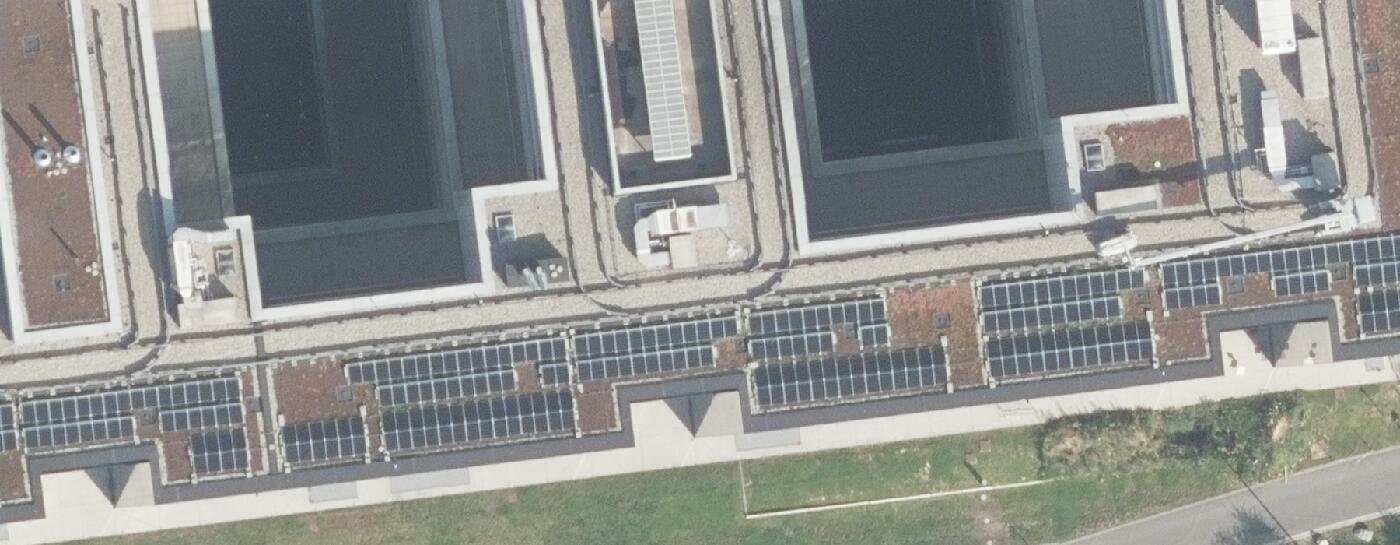
Your PV installation in Brussels is above the telecontrol threshold, and Sibelga asks you to connect the generation to its telecontrol cabinet. On paper, the requirement fits in a few pages. On site, it is often the last open item before commissioning, the one that delays acceptance while the panels have been in place for weeks. Here is what we learned from two projects carried out for a PV installer: a hospital, then a four-building campus.
What Sibelga asks for, in short
Above a certain power threshold, Sibelga must be able to limit remotely the generation injected into its grid. For new installations, this threshold went down from 1 MW to 500 kVA with the revision of Sibelga's CCLB 111 prescription, approved by Brugel in September 2024: more and more installations are concerned.
The principle is simple. Sibelga places a telecontrol cabinet (RTU) in the substation. Your installation talks to it over a Modbus serial link, sends back a number of measurements and states, and applies the setpoint it receives: a maximum generation percentage, or a full stop if the installation cannot be regulated. Before the tests, Sibelga validates the chosen principle, then comes on site to check that everything works.
None of this is out of reach. But every step requires speaking the language of the grid, of automation and of the end client at the same time.
Why it often gets stuck
For a PV installer, telecontrol sits at the edge of the trade. Inverters, protection and the grid connection are well mastered. The interface with the grid operator, much less. The difficulties we see again and again:
- A requirement that comes late, when the site is almost finished and the communication cabling was not planned.
- An exchange table to follow to the letter, with conventions that cannot be improvised.
- Inverters, meters or loggers that do not all speak the same language, or cannot be controlled at all.
- The end client's IT network: addresses, security, access, with an IT team that has its own lead times.
- A design review by Sibelga with precise questions, to be answered before a test date can be set.
- On-site tests where everything must work the first time, because rescheduling a visit takes time.
None of these points is blocking on its own. Together, they can push commissioning back by several weeks.
Multi-building sites, a case of their own
On a campus or an industrial site, generation is often spread over several roofs, with several inverters and meters, sometimes installations of different ages and brands. Sibelga only sees one connection point and expects a single response to its setpoint.
A layer of intelligence is therefore needed to bring these installations together and present them to the grid as a single generation unit. This is what we designed for a four-building campus in Brussels: a central PLC, placed under Sibelga's cabinet, which aggregates the installations and distributes the setpoint. And when the existing inverters cannot be controlled, there are ways to meet the setpoint without replacing them.
What we bring to the installer
- A single point of contact for the whole telecontrol scope, between the installer, the end client, its IT department and Sibelga.
- An architecture suited to the site, independent of manufacturers, that makes the most of the equipment already in place.
- A design principle submitted to Sibelga early, so that approval is not the critical path.
- Programming and commissioning of the interface, with our own dry runs before Sibelga's visit.
- A principle already validated on previous projects, which reduces back-and-forth, surprises and study costs.
The installer keeps control of the site and of the client relationship. We take care of the part that is outside the trade, and that must not delay acceptance.
Where to start
The best time to talk about it is before ordering the equipment, while cabling and equipment choices can still include telecontrol at no extra cost. But even on an advanced site, there is almost always a solution.
Send us the single-line diagram, the installed capacity and the list of inverters and meters: within a few days we will tell you what to plan, and in what order.